




Is Plushie Design Difficult? Unraveling the Art and Craft
The seemingly simple plushie—a soft, huggable companion—often belies the intricate process behind its creation. To answer the question "Is plushie design difficult?" is to explore a discipline that sits at the fascinating intersection of art, engineering, and psychology. The short answer is: Yes, it can be deceptively challenging, but its difficulty is precisely what makes it a rewarding craft.
The Deceptive Simplicity: Where the Challenges Begin
At first glance, designing a cute bear or a simple animal might not appear complex. However, transforming a 2D concept into a 3D, tactile, and emotionally resonant object involves navigating multiple layers of difficulty:
1. The 2D to 3D Translation Puzzle: This is the core intellectual challenge. A charming illustration on paper does not automatically become a cuddly 3D form. The designer must deconstruct the character into a sewing pattern—a flat blueprint of odd-shaped fabric pieces that, when sewn and stuffed, will magically inflate into the desired shape. Calculating darts, seam allowances, and fabric stretch to achieve correct proportions without distortion requires spatial reasoning akin to architecture.
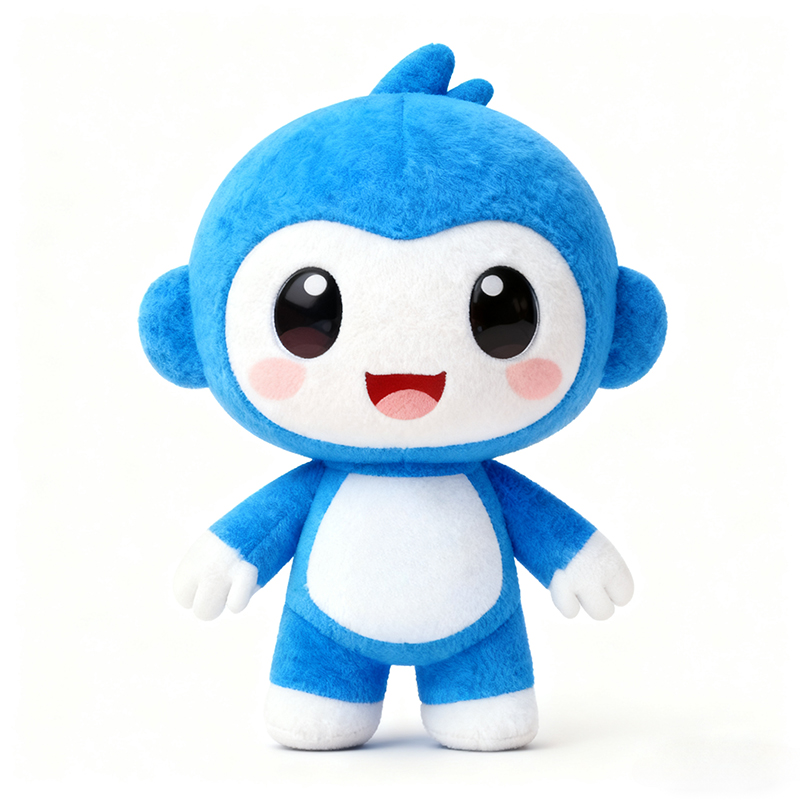
2. The "Cuteness" Equation: Engineering appeal is not straightforward. It involves a nuanced understanding of proportions. Exaggerated features—large heads, big eyes placed low on the face, and small bodies—trigger nurturing responses. Finding the perfect, balanced ratio that evokes the intended emotion (cuteness, majesty, silliness) is a subtle art. A millimeter’s shift in an eye’s placement can change a friendly face into an uncanny one.
3. Structural Integrity vs. Huggability: A plushie must be durable enough to withstand love yet soft enough to invite it. Designers must decide on seam types (e.g., strong backstitch vs. neat ladder stitch), stuffing density (firm for shape retention, soft for cuddliness), and joint construction (for poseable limbs). Poor internal engineering leads to floppy necks, burst seams, or lumpy bodies.
4. Material Mastery: The choice of fabric dictates the final result. A design drawn for minky fabric will look and behave very differently if made with faux fur or cotton jersey. Designers must understand how different piles, stretches, and textures interact with their patterns. Furthermore, selecting safe, durable materials for details like eyes (preferring embroidered over plastic for infants) is crucial.
The Gradients of Difficulty: Not All Designs Are Equal
The difficulty spectrum in plushie design is wide:
- Simple, Stylized Shapes: A basic "pillow-style" shape (like a rainbow or a cloud) is an accessible starting point for beginners.
- Complex Organic Forms: Designing an accurate, detailed dragon with wings, horns, and scales, or a realistic animal with proper snout structure, is highly advanced. It requires multiple pattern pieces, color blocking, and sophisticated stuffing techniques.
- Artistic vs. Commercial Design: A one-of-a-kind art piece allows for more complex, fragile techniques. Designing for mass production, however, adds constraints of cost, machine sewing feasibility, and strict safety regulations, which is a challenge of its own.
The Tools That Tame the Difficulty
While challenging, the process is supported by specialized tools and methods:
- Digital Aids: Software like Clo3D or even Adobe Illustrator helps visualize patterns and make adjustments before cutting fabric.
- Prototyping (Mushing): Creating quick, rough drafts with cheap fabric ("muslins") is essential to test and refine the 3D form.
- Specialized Knowledge: Understanding grading (scaling a pattern to different sizes) and nap (the direction of fabric pile) is part of the professional skill set.
Conclusion: A Rewarding Discipline
So, is plushie design difficult? It is a craft that demands a dual mind—the creative vision of an artist and the pragmatic problem-solving of an engineer. It requires patience to endure the trial-and-error of prototyping and a keen eye for subtle emotional cues.
Yet, this very complexity is what makes it profoundly rewarding. The moment a flat piece of fabric transforms into a dimensional character, filled with personality and ready to be loved, represents a unique magic. For those passionate about bringing joy to life through tactile form, the challenges of plushie design are not barriers, but rather the engaging puzzles that make the final, huggable success so satisfying. It is difficult, but wonderfully so—a testament to the fact that creating something truly comforting is never a simple task.